

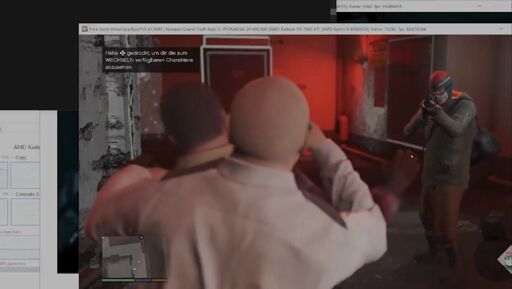
And how many fps does it run after the crash?
A user you’ve blocked has previously contributed: claude
What could possibly need this here?
opens front page
Oh my pccccccccccccccccccc
And you’ll need 1 whole data center to run the emulator.
The PC running it has a Ryzen 7 9950X3D CPU and an RX 7900 XT GPU
Seems very CPU dependant.
Isn’t PS5 x86?
On a normal PC that’s more like specialized virtualization rather than emulation. It should run decent.
It’s emulation. The CPU architecture is only one piece of the puzzle. The PS5 runs a custom operating system with custom graphics APIs and unified memory.
Isn’t Proton solving the same problem though?
Yes. But Proton has the advantage of working with well documented APIs on both sides. All the PS5 stuff is proprietary and has to be reverse engineered, that’s why it doesn’t work so well.
Ok, so if it’s translating to a reverse engineered API, it’s emulation. But if it uses the proprietary documentation and does the same exact translation it…wouldn’t be emulation anymore? What part are we saying is being emulated again?
I didn’t say anything to that effect
I’m trying to understand, what is being emulated?
You said it’s emulation because it handles ps5’s graphics APIs and unified memory. I noted that proton is also translating vulkan to another graphics API. You said it’s different because the api we’re targeting is proprietary and needs to be reverse engineered, implying that is the distinction. Right?
So then doesn’t that imply that if we did the same thing, but without needing to reverse engineer anything, it would now be an apples-to-apples comparison with what proton is doing?
It’s a Zen 2 APU. It could run any other x86_64 OS in theory. There’s no need to emulate the whole system if you’re running it on an x86_64 machine. It shouldn’t be wholly impossible to just run it as a VM and save the overheard of translating instructions to the same instructions.
My reply to your comment would be the same one you replied to. That’s not how it works. The translation layer is required. Having the same clue architecture is not good enough to just run the games natively. If it were, Proton wouldn’t exist and Linux and Mac gaming would have been solved a decade ago.
You already don’t need to emulate the entire hardware system like you would with a PS3, but you still require a complex translation layer.
You already don’t need to emulate the entire hardware system like you would with a PS3, but you still require a complex translation layer.
I think this is their point, just worded better. Wine and Proton are not “emulators”, but translation layers like you are describing.
Although I have no idea what they are talking about in regards to virtualization - being able to install Linux on a PS5 doesn’t get me any closer to running PS5 games on Linux, and I can’t even imagine the virtualization headaches to get the PS5 OS running in a VM with enough access to the hardware to not blow chunks (and honestly sounds a lot closer to true hardware emulation than not).
My problem with their point isn’t really the semantics as much as that they seem to be under the impression that it should “just work” when we can clearly see by the above article, it doesn’t.