


Instead of instantly knowing the results of who will be president, we Dutch enjoy a democratic tetris of multicolour politics.
Be thankful that you have that option. Look at the US or UK to see the failures of a first past the post voting system.
We’re getting closer to proportional representation in the uk! PM just started the first step a few days ago, I just hope it doesn’t stall and end up a damp squib.
And when you manage to put the House of Lords into the history bin and replace it with an upper house representing the Counties/Shires, your democracy would have arrived in the 20th to 21st century. Which is far ahead of the US…
Yeah I love it, its better that most systems I’ve heard of, hate how the larger parties are mostly right-wing.
Ranked voting looks interesting too, as is solves the swing votes from one to another, lots of Socialist Party voters sway to the Fascist FvD, and Liberal (D66) voters that occasionally vote Social Democrat (Pvda). And we also get one issue parties that matter for the year but loos support quickly afterwards.
I’ll defend it until I find something better.
imagine having to wait until after the election ends to know the result. this comment was brought to you by the authoritarian dictatorship inc., elect 1 dictator and get 1 free
I think you’ve lost me, my country has 15 different political parties in parliament.
As most of the large parties had hard NO on other parties thus: a minority formation still needs to find majority consensus with the parliament on most matters.
You’re not special, we do similar nonsense in Germany, only we have a 5 percent hurdle which does make it easier to predict. And doesn’t result in four-party-coalitions*, goodness gracious, that sounds stressful. Is that normal?
* instead it’s usually two of the same four parties. I don’t know if that’s better.
Edit: I realised that my tone probably doesn’t translate to text. I do definitely prefer this over other systems, I’m just also aware of its absurdities, like the squabble over who’s going to coalitionify whom.
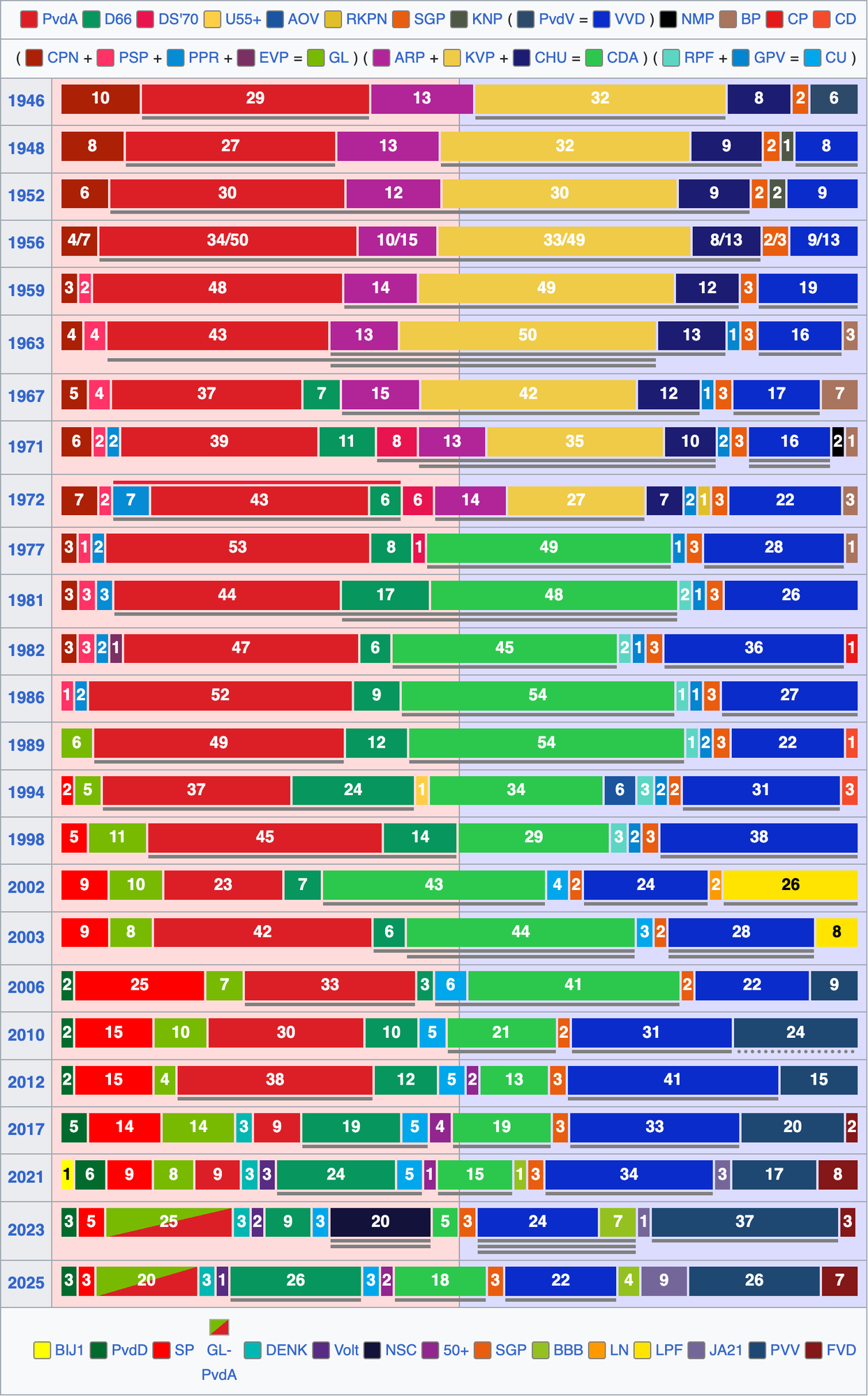
We currently have a strange minority coalition ( D66: 26, VVD: 22, CDA: 18 ) which means that for most laws that they still need to find a majority. Having a 5 percent hurdle seems dangerous as it further limits small parties that often add unique perspectives that can get a majority but wouldn’t be a priority or focus otherwise.
Yep, the hurdle is contentious to say the least. It was established to prevent a repeat of the Weimar Republic where the splintering made parliament incapable of doing anything productive (after which the 1930s happened). You are correct though that having small parties represented in parliament does have its advantages which we’re missing out on.
Didn’t want to imply your system is bad or anything, far be it from me. A four party coalition just looks unusual from where I am, that’s all I wanted to express :)