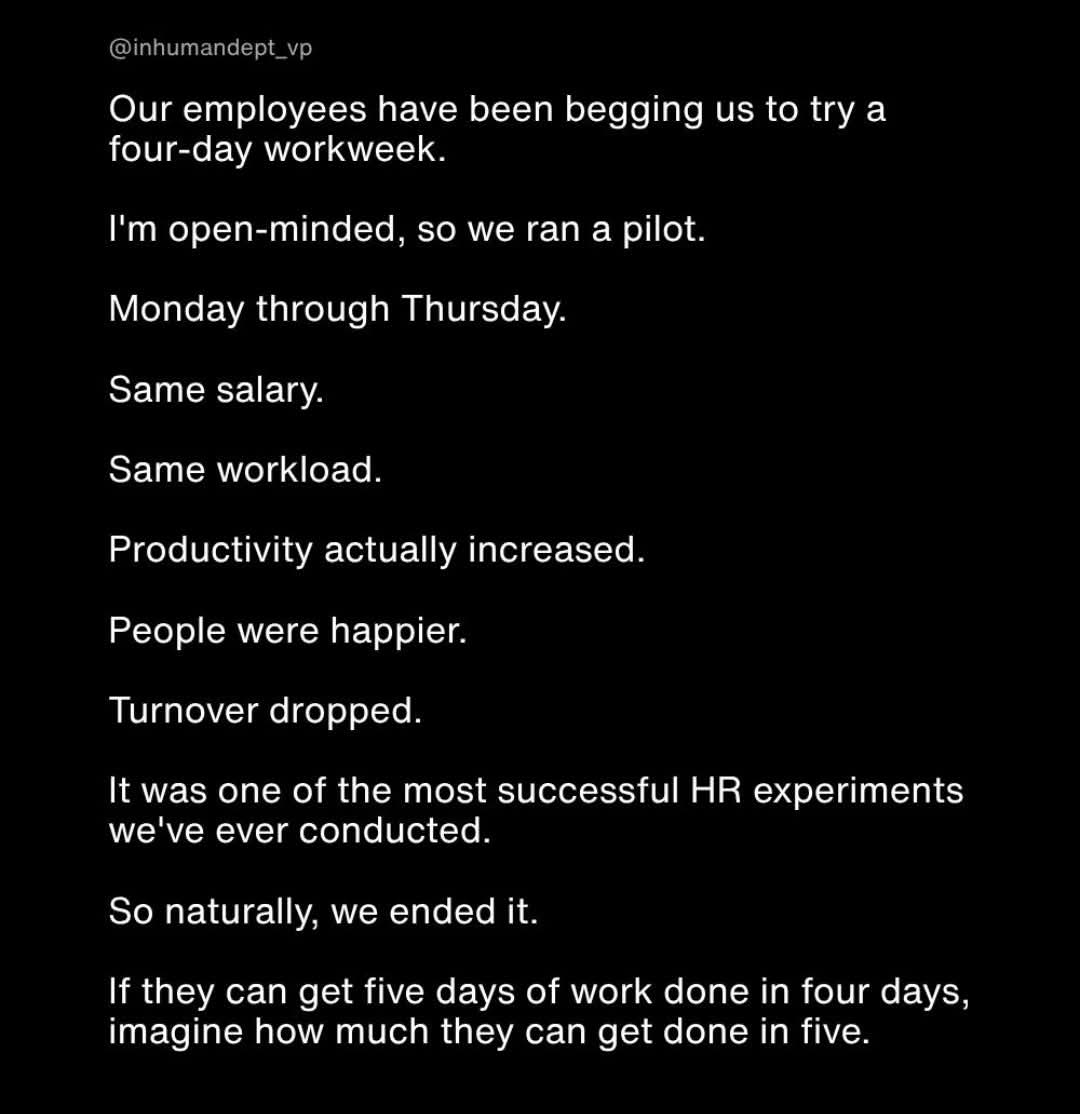

I’d laugh, but this just seems like it would actually happen.
This happened to me.
I requested four days and laid out a plan on what “success” looked like. We tried it. After six months my boss and I agreed all my metrics had improved, so he put me back in five days because “imagine how productive you’ll be now”, so I quit a couple of months after.

When I accepted my current job, I did so on the conditions that I’d work 4x10 and fully from home (after training). When I started, they said there had been a misunderstanding about full WFH and that I was allowed to WFH one day a week. (That eventually changed during COVID but no one ever apologized to me for lying to me.)
Seven years later - last year - they told me that it was “unfair” that I’m the only person who had a special schedule (apparently I was the last person to have it, but I certainly was not the only) and took that away, too.
I live in a rural area and will not be able to find a comparable job nearby. I’ve been contemplating what to do.
Wanna share the plan? I’m still trying to come up with something for my boss.
Yes! I had an engineering management role in a smallish company, which means that I still had a lot of hands on responsibilities, so not sure how things apply to your role. But a lot looked like this:
- we set out what we expected would be achieved in six months (major projects or milestones) <- we ran a roadmap that got fuzzy with time so this was more a vibe check than commitments
- we defined what would be signs that it wasn’t working. Eg. Projects stalling, teams confused about direction, feedback from the team, lowering of certain metrics.
- we set up checks every two months that included feedback from direct reports and one over.
- I picked Wednesday. we set out how the calendar was going to change, how handover was going to work for those days and what mechanisms existed to avoid blocking.
It went great! Especially as a manager knowing you’re not always there helps drive decision making delegation, self directedness, etc.
In this team I wasn’t the only one that tried it, and we didn’t synchronize days. It had no issue
Also depending on where you are, it might be moot. Eg. In Germany they can’t say no unless they have business reason.
Beware the word moot has opposite meanings to people from the US and UK.
US takes it as something that can be ignored like it’s from practice in a moot court (or mock trial)
UK takes it from the meeting type (a moot) and the word means something that should be discussed
Australia mostly follows US usage in this
“So we went back to five days, and now productivity is down to effectively three days, what went wrong?”
Executives, everywhere.
“so I started
blastingfiring people”
This is genuinely how MBAs think
The problem is the workplaces don’t want that. if you’re happier and have more energy, it also makes you more uppity and harder to control. You might even find options for other work!
If it means keeping you tired and broken, that’s worth the cost of a little productivity.
But is that really so? i would think that a better work life balance makes the employees inclined to remain at their job instead of hopping elsewhere. Probably even at the expense of a higher salary at another place that would instead demand the grind again.
Take a look at our little friend remote work. Almost all employees love it. Retention is thru the roof at places that offer it. More than half of workers say they’d even take a pay cut to keep it. Productivity isn’t affected in most cases (ymmv obviously). Buuuuut guess who absolutely can’t stand it? Management. They’ll go to the ends of the earth to make sure you don’t get it. Ask yourself why.
You’re not accounting for the emotional needs of management. Many of them are cruel. They put value in making their workers squirm.
We should have worker owned things instead of the petty tyranny of capitalism, but here we are.
as a manufacturing worker, this argument doesn’t work for us. every second of our day is already mapped out anyway, we’re struggling to keep the breaks we have
while we know this post is fake, this is the logic capitalists use. it is the logic they hide, the lede they bury, when they report on how efficient ai will make us.
Productivity isn’t a straight line, which is where most businesses fail in their thinking. Yeah I can do five days of work in four days, with the right incentives. I can also do it in five with no incentives.
I can do three days of work in five days with the wrong incentives :)
I used to work at a university whose education department sank hundreds of thousands of dollars into a study to find ideal lecture length to maximize retention.
Memory’s a little fuzzy… it was short. Like a half hour?
Anyway the punchline I definitely do remember is that they got the results of the study then changed absolutely nothing
“We funded this study hoping it would conform to our existing world view, Alas it didnt, there for we’re not changing a fucking thing”
Thats pretty much the status quo of science under wealth inequality. I invent AI studies to confirm my biases too. The current study is “can an AI legislate better than mitch mcconnell”
Let’s start with Lindsey Graham and go from there.
All of them, and we should use the AI to spy on them and use the PATRIOT ACT data to see everything they’ve done in said in the last 100 years and summerize it for us. I’m totally ready to adopt this technology and use it against the people who would use it to control me.
If productivity increased then you had some slackers before
4 day work weeks often means working four 10hr shifts. Same hours but less start and stop adds to productivity, and that extra day off during the work week means you can schedule things that day that otherwise would require time off during work hours. That extra day off really helps both employer and employee.
4 tens is so much better than 5 eights.
4 tens is so much better than 5 eights.
Going to need a citation for that, because that is not what the research I’ve seen suggests.
From this paper:
This paper studies the link between working hours and productivity using daily information on working hours and performance of a sample of call centre agents. We exploit variation in the number of hours worked by the same employee across days and weeks due to central scheduling, enabling us to estimate the effect of working hours on productivity. We find that as the number of hours worked increases, the average handling time for a call increases, meaning that agents become less productive. This result suggests that fatigue can play an important role, even in jobs with mostly part-time workers.
The full article is behind a paywall, but the discussion paper is available in full here.
Another paper suggests that, while same-day performance can sometimes increase with number of hours, next-day performance suffers. And, more importantly, routinely working shifts that are longer than 8 hours reduces productivity over time:
To start, we elucidate the tension between a widely held assumption grounded in the ideal worker norm that working long hours boosts performance and recovery research suggesting the opposite. Our findings reveal that, although working a long day is associated with a same-day performance boost, working long hours hinders overnight recovery by reducing sleep, hindering next-day performance. Our results also cautiously suggest that regularly working longer than 8-h days results in fatigue and a lack of resilience, making it difficult for employees to sustain high levels of performance over time.
I have consistently seen the four-day workweek defined as 32 hours per week (4x8hr), not 4x10hrs.
That’s why we need to end the push for the 4-day week.
And start the push for the 32-hour week.